



MARGORIE PRIME
AT THE HAYS THEATER

“Marjorie Prime” has now made its way to The Hayes Theater on Broadway with a great cast to help Jordan Harrison’s vision explore AI, death, and longing.
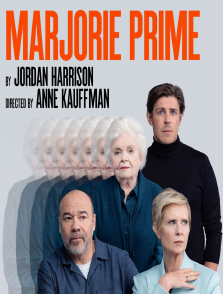
“Marjorie Prime” has the same director as ten years ago (Anne Kaufman). The main star today is June Squibb (it was Lois Smith at Playwrights). Squibb is very effective in her role as Marjorie. She is both comedic and pensive; her deliveries most times are precious. Cynthia Nixon, too, is at the top of her game as a somewhat bitter woman who questions her own mortality as a middle-aged woman. Her husband, Jon (Danny Burstein), is a warm, caring man who helped Marjorie interact with her dead husband, Walter (Christopher Lowell), via computer.
We learn about Walter’s and Marjorie’s life together as information is fed into the prime. The prime learns more and more about Walter as the play goes on, and at times the play gives us only little tidbits of warmth and feeling. The writing never hits the chords that it should, and that left me wanting more from this show. The direction never pulls at our emotional cords as it should have.
Lee Jellinek’s scenic design with a 70’s style green-colored set has sharp angles; the sharpness may well signify the cut-and-dry life of all four characters. Trapped in what could have beens, Jon seems like the only one content of the four. Happy in his marriage, his life, he goes about life wanting to help, to fit in with the family.
Ben Stanton’s lighting was without question the most interesting part of the evening. He captures the many moods that this show has. He is deft in the way he spreads the field when needed under the mostly romantic lighting. Ms. De La Rosa’s costumes are well done, especially on Nixon’s character. Tess is a woman of means; her style is always eye-catching every time she steps on stage.
“Marjorie Prime” is not a show for everyone; the subject matter may not please the passive theatergoer. The plot is not an ordinary one and the occasional audience member may just not be interested in its writing. After all, it is a play where an 85-year-old woman speaks to her dead husband!